
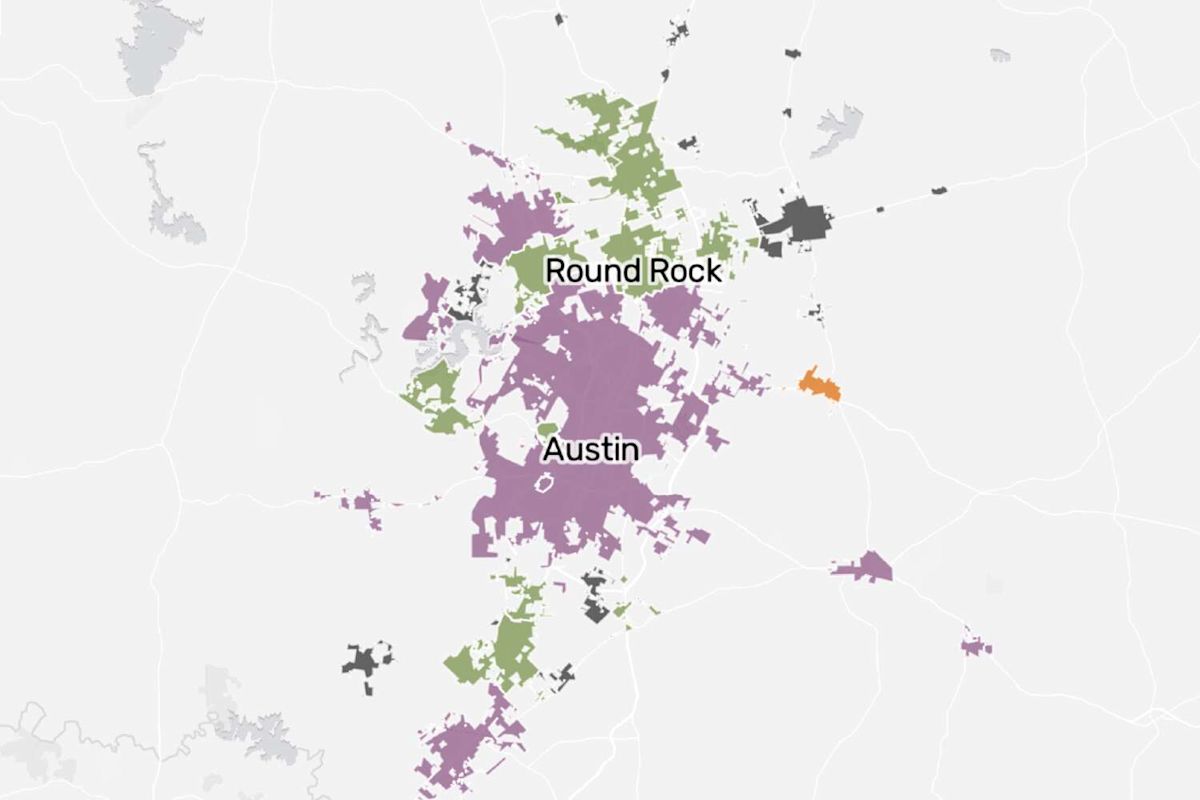
Across Central Texas, municipal leaders are grappling with sharp disagreements over automated license plate reader technology, resulting in a fractured landscape where neighboring communities maintain entirely different surveillance practices. An extensive examination of city records, news reports, and local municipal disclosures spanning Travis, Williamson, Hays, and Bastrop counties highlights how public pushback and privacy concerns are rapidly reshaping law enforcement tools in the region.
The ongoing review reveals a stark division among regional governments regarding the automated cameras, which capture images of passing vehicles to track movements. Currently, nine Central Texas municipalities continue to deploy license plate reader systems within their jurisdictions, while another nine cities have formally moved to terminate their vendor contracts. Meanwhile, one city has placed its program on pause, and several others have opted not to implement the systems at all.
Among the jurisdictions that actively maintain the technology are Bee Cave, Buda, Cedar Park, Georgetown, Hutto, Lakeway, Mustang Ridge, Round Rock, and West Lake Hills. Law enforcement agencies in these nine communities continue utilizing the devices as operational tools, relying on automated scans to gather vehicle information within their municipal boundaries.
Conversely, an equal number of regional municipalities have completely severed ties with their automated license plate reader providers. The list of cities that have terminated their vendor contracts includes Austin, Bastrop, Lago Vista, Leander, Liberty Hill, Manor, Pflugerville, San Marcos, and Sunset Valley. In addition to these formal cancellations, officials in Elgin have temporarily halted their surveillance program, putting their operations on pause.
Other jurisdictions in the four-county area have avoided adopting the systems altogether. Municipal representatives in Dripping Springs, Rollingwood, and Smithville have confirmed that they do not utilize automated license plate readers. However, the exact status of surveillance technology remains unknown in a dozen other regional localities—Bartlett, Coupland, Creedmoor, Florence, Granger, Jarrell, Jonestown, Taylor, Thorndale, Thrall, Weir, and Wimberley—after local officials failed to respond to inquiries regarding their practices.
In the Hays County city of Kyle, elected officials took a distinct approach when confronting the issue. During a Sept. 5 meeting, the Kyle City Council opted against immediately terminating the city’s agreements with Flock, an Atlanta-based surveillance vendor that has become the focal point of widespread community criticism. Rather than canceling the contract outright, council members agreed to consider placing an advisory, nonbinding proposition on the May 2027 municipal ballot to allow residents to vote on the future of the technology.
The regional resistance to license plate cameras gained significant momentum following developments in Pflugerville late last month. On Aug. 25, the Pflugerville City Council decided to cancel its ongoing contract with Flock after a resident formally requested audit logs detailing which external law enforcement entities had conducted searches through the city’s captured data.
The decision in Pflugerville sparked a swift chain reaction across neighbouring communities. Local governing bodies in Manor, Leander, and Elgin moved in rapid succession to either cancel or suspend their existing programs. Taking the pushback a step further, the Bastrop City Council not only terminated its vendor relationship but also enacted a total ban prohibiting the deployment and use of automated license plate reader systems within the city.
This local backlash coincided with significant actions taken at the state level. Texas Gov. Greg Abbott previously issued a directive instructing state agencies to halt all public expenditures directed toward Flock camera technology, adding institutional momentum to municipal reassessments across Central Texas.
The shift away from direct camera ownership has also created unique operational arrangements in major metropolitan areas, most notably in Austin. The Austin Police Department lost direct access to the vendor’s primary database once the city’s contract with Flock concluded in 2025. Nevertheless, city law enforcement officers are still capable of obtaining automated vehicle surveillance information through external partner agencies that maintain lawful access to the system.
Austin’s reliance on informal sharing channels has prompted scrutiny from policy observers and privacy advocates. The city currently operates without formal, written inter-agency agreements governing these external data requests, nor does the police department systematically log or track such inquiries. This procedural gap has led to lingering questions regarding the volume of information exchanged and whether such indirect access circumvents municipal surveillance oversight rules.
The debate surrounding automated readers centers on competing priorities between community safety and constitutional privacy protections. Proponents of the technology argue that automated camera networks serve as essential investigative assets for modern police departments. Supporters maintain that real-time license plate detection plays a vital role in apprehending criminal suspects, recovering stolen vehicles, and assisting authorities in locating missing or endangered persons.
On the other hand, critics argue that the indiscriminate tracking of vehicle locations creates an invasive mass surveillance apparatus. Opponents emphasize that building searchable databases containing historical travel patterns poses severe risks to civil liberties, particularly when private vendor data is indefinitely preserved or shared across diverse law enforcement entities without adequate safeguards.
As regional municipalities continue to weigh public feedback against operational policing desires, Central Texas remains a key testing ground for the future of automated vehicle tracking. With several programs already dismantled and public votes on the horizon, the balance between public safety technology and digital privacy remains an unresolved issue across the region.






(0)