
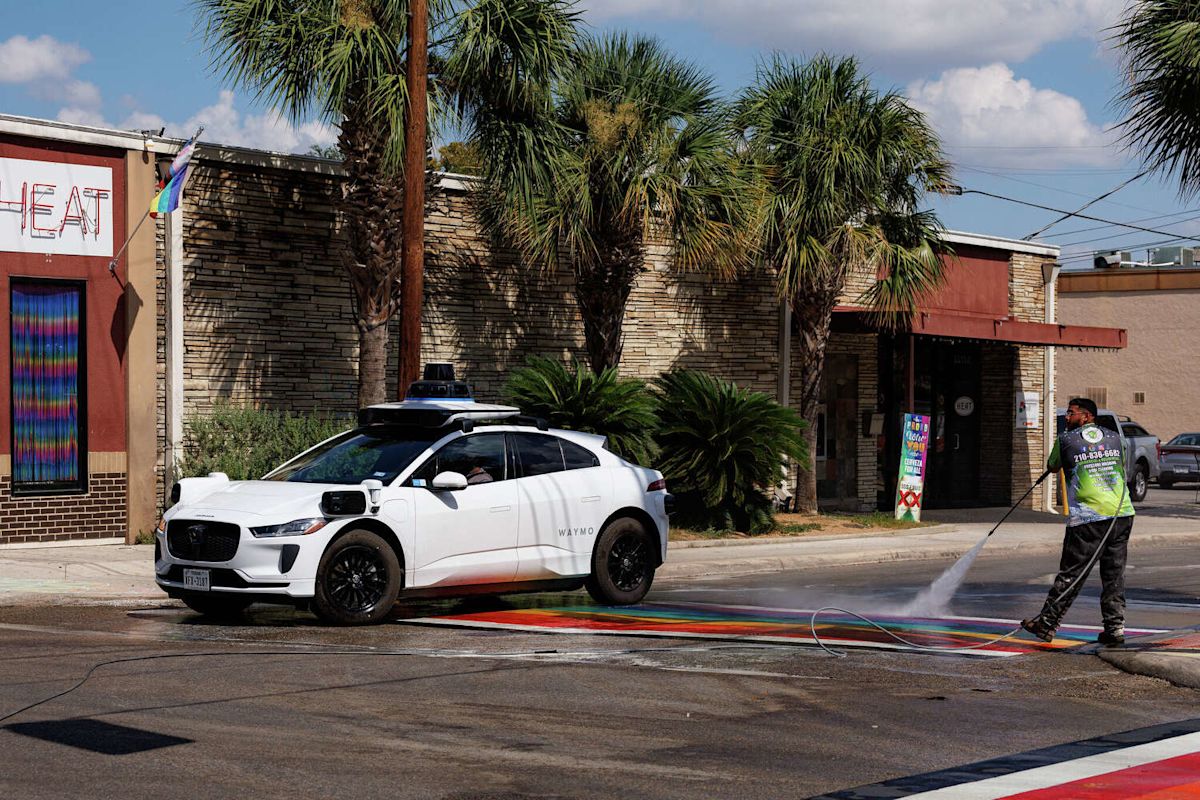
Hundreds of pages of law enforcement files reveal that Waymo’s fleet of autonomous robotaxis encountered persistent operational challenges across San Antonio prior to the temporary suspension of its local commercial service. The public records depict a wide range of roadway complications, illustrating the intricate obstacles autonomous driving technology confronts when navigating urban corridors built for human drivers.
Waymo, an autonomous vehicle company spun out of Google, halted its passenger ride-hailing service in the city in April after one of its vehicles was swept off a flooded roadway during severe weather. Although commercial passenger operations remain paused, the company has since resumed road testing with its fleet of autonomous Jaguar I-PACE sport utility vehicles across the municipality.
A comprehensive review of 270 pages of police records documents numerous calls from residents, motorists, and emergency responders regarding the sensor-laden vehicles. While the majority of logged incidents involved driverless vehicles obstructing travel lanes, emergency dispatchers also cataloged reports of collisions, vehicles stranded in high water, complaints alleging reckless or wrong-way driving, and three separate incidents where cats were struck by the robotaxis.
Despite the frequent calls logged by emergency dispatchers, the self-driving vehicles did not cause any human injuries while operating in autonomous mode. However, the records detail an April crash that resulted in the hospitalization of a pedestrian, an incident that occurred while an in-vehicle human specialist was manually operating the vehicle rather than the automated driving system.
Beyond logging traffic slowdowns, the police files provide insight into the broader operational dynamics of testing emerging technology in complex environments. The documents highlight how frequently the autonomous vehicles required manual human intervention when encountering confusing scenarios, how members of the public interacted with the equipment-mounted vehicles, and how onboard video capabilities can assist local law enforcement in investigating criminal activity.
In response to the documented police calls, Waymo representatives stated that official incident logs do not provide a complete picture of the company's autonomous performance. Waymo spokesperson Nye Davidson emphasized the necessity of distinguishing between an administrative police record that simply mentions an autonomous vehicle and an actual emergency where a vehicle actively required police assistance.
Davidson noted that many of the reported incidents lacked clear indications of whether any police follow-up occurred or was even necessary. As a result, the company pushed back against characterizing the collection of records as roughly 50 operational failures directly attributable to Waymo's automated driving system.
Between June 2025 and the April service suspension, police dispatch received at least 24 distinct calls regarding Waymo vehicles stopping in intersections, roadway travel lanes, residential driveways, and road shoulders. These incidents were distributed across the company’s 60-square-mile San Antonio operational zone.
The traffic disruptions were largely concentrated along major travel corridors in the north-central and near-downtown districts. Frequent locations cited in police reports included Interstate 35, Basse Road, Austin Highway, New Braunfels Avenue, San Pedro Avenue, and Harry Wurzbach Road.
Individual incident reports detail the specific infrastructure and signal anomalies that confused the autonomous driving software. On April 3, two Waymo vehicles came to a prolonged halt at the intersection of Burr and Wurzbach roads when a traffic light became stuck on red, forcing surrounding motorists to navigate around the stationary SUVs. Five days later, another Waymo became immobilized at McCullough Avenue and Basse Road due to malfunctioning railroad crossing arms.
Other documented occurrences required patrol officers to take direct action to clear blocked lanes. On February 3, two officers assisted in removing a disabled autonomous vehicle that had stalled along an Interstate 35 frontage road. Later in April, two robotaxis were reported blocking the intersection of New Braunfels and Cloverleaf avenues diagonally, though both cars had departed by the time an officer arrived.
A breakdown of the 24 traffic-obstruction reports reveals a variety of resolutions. In 12 cases, the vehicles had cleared the area or were no longer impeding traffic when law enforcement arrived. Nine instances required active intervention from police officers, dispatchers, or Waymo operations personnel, while two lacked a recorded outcome and one was determined not to be a traffic hazard.
The broader operational friction between driverless fleets and emergency responders has drawn oversight from local and federal officials. In late 2025, the San Antonio Police Department and the San Antonio Fire Department held joint training sessions with Waymo staff to instruct emergency personnel on safely interacting with the automated vehicles, an area that has also drawn safety advisories from the National Highway Traffic Safety Administration regarding first responder interference.
Community confusion regarding the autonomous vehicles has also generated public speculation. After an image circulated on social media depicting a marked police cruiser positioned behind a stationary Waymo on San Pedro Avenue near West Elmira Street, police spokeswoman Julyssa DeLuna clarified that the officer had not initiated a traffic stop, explaining that the vehicle was already stalled and the officer merely helped relocate it to a safe position.
As Waymo continues testing its fleet, the broader autonomous vehicle sector in San Antonio continues to expand. Local officials have recently cleared the way for additional competition in the market, granting municipal approvals for Tesla to develop a dedicated robotaxi facility near the city's airport.







(0)