
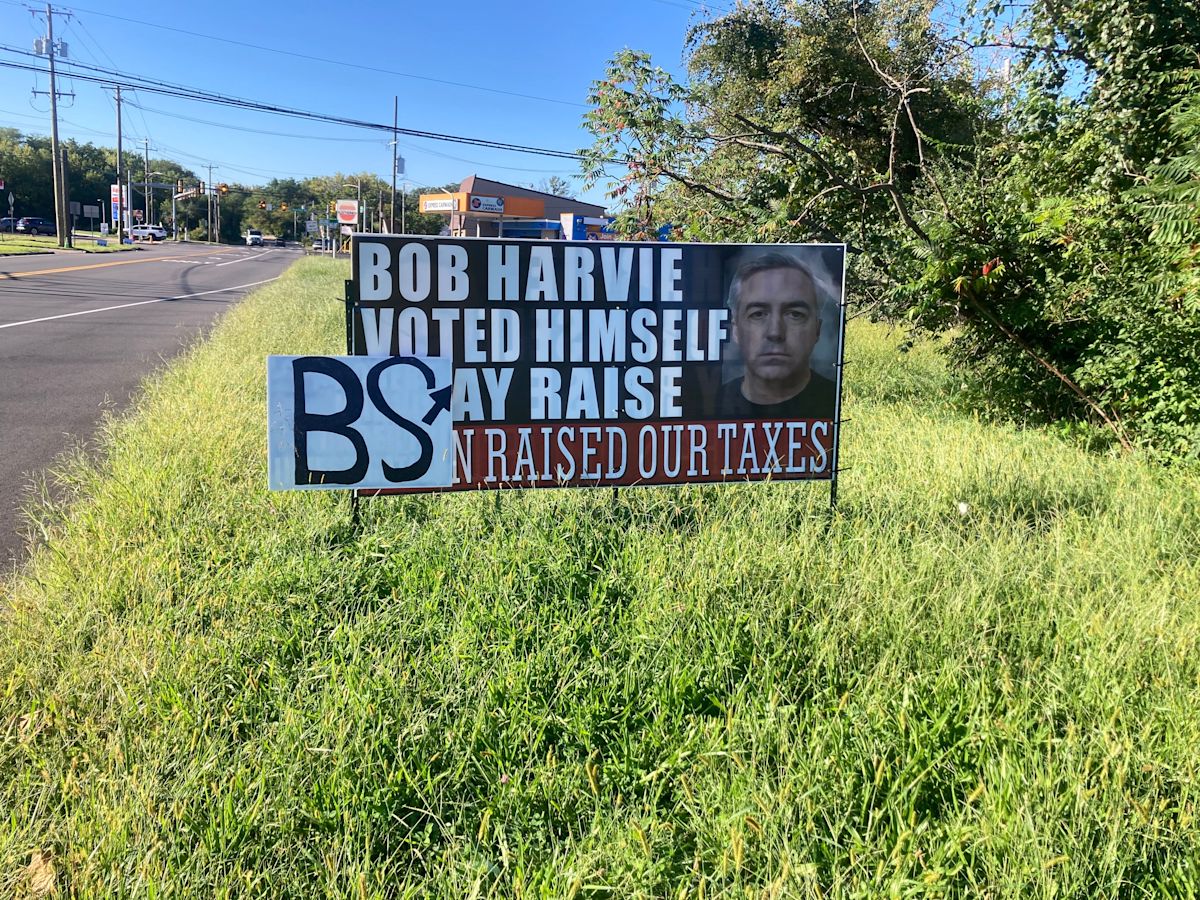
Middletown Township is advancing sweeping modifications to its local sign regulations, establishing uniform rules for all temporary signage across the community while attaching substantial financial penalties of up to $500 per day for infractions. The local governing body recently took decisive action by unanimously approving the advertisement of the revised ordinance, setting the stage for strict new standards that will significantly alter how political campaign banners, commercial advertisements, and residential notices are displayed throughout the municipality.
The primary motivation behind Middletown’s regulatory overhaul is the legal obligation to comply with federal standards governing freedom of expression and public property management. Municipal leaders are responding directly to a pivotal May 2024 decision issued by the U.S. Third District Court. That federal ruling instructed every municipality across the Commonwealth of Pennsylvania to treat temporary public signs in an identical manner, effectively prohibiting local governing bodies from favoring commercial advertisements over personal or political speech.
The federal legal precedent originated from a legal challenge in Camp Hill Borough, where previous municipal policies were deemed unconstitutional under the First Amendment. In that case, federal judges found that local officials had established an unlawful framework by granting preferential treatment to real estate "for sale" signs and commercial notices while severely restricting signs carrying personal political opinions. Camp Hill had capped personal expression signs at just two per property, creating what the court characterized as a confusing "crazy quilt" of rules that penalized political discourse while leaving business promotions and seasonal holiday greetings completely untouched.
To eliminate similar legal vulnerabilities in Bucks County, Middletown's proposed ordinance eliminates all distinctions based on the content or viewpoint of a sign's message. Under the updated policy, any temporary sign—ranging from announcements for youth baseball sign-ups to private service advertisements for power-washing businesses or residential holiday light installers—will face the exact same township oversight and stringent rules.
Even standard real estate "for sale" signs positioned in front lawns will no longer be granted special statutory treatment. Every temporary display erected anywhere within the township will be subject to the same placement and sizing regulations, ensuring that commercial sales notices and private expressions are held to identical standards under municipal law.
A central provision of the proposed ordinance is a complete prohibition on placing temporary signs within public rights-of-way. Regardless of the message, commercial intent, or civic organization involved, no signs of any kind will be permitted to stand inside township rights-of-way, which are most commonly found along busy transportation corridors and major road networks.
Township officials pointed out that while state-level prohibitions have existed for years along major state-managed routes, local enforcement has historically been inconsistent. For example, the Pennsylvania Department of Transportation has maintained longstanding restrictions barring temporary signage within state rights-of-way, such as Bristol-Oxford Valley Road in Levittown, though those state rules were rarely enforced in practice. Middletown’s new measure aims to establish clear municipal authority and consistent enforcement across all township roadways.
Political campaigns and local candidates are expected to feel the greatest impact from the township’s new regulatory schedule. The draft ordinance institutes strict timeline limits on election displays, dictating that political campaign signs cannot appear more than 30 days prior to an election. Furthermore, candidates, campaign organizers, and property owners will be required to dismantle and remove all political signs within 10 days after the election has concluded.
Beyond timing and location limits, the township is also instituting strict dimensional caps for temporary signage erected on private property. According to the proposed measure, an individual sign may not exceed 12 square feet in total size. In instances where multiple signs are placed on a single property, the combined area of all signs cannot exceed a total of 24 square feet.
Enforcing these standards across Middletown presents notable administrative hurdles due to the municipality's geographic expanse and sizable population. Boasting approximately 50,000 residents, Middletown is among the largest and most populous municipalities in Bucks County. Township Solicitor Jim Esposito explained that the community is simply too large and active to deploy a dedicated roving crew specifically tasked with patrolling roadways for non-compliant signs.
Rather than allocating personnel exclusively to sign enforcement, the township plans to integrate removal efforts into existing public works operations. Township road crews who are already traveling across Middletown performing their standard maintenance duties will be instructed to pull down and confiscate illegal signs whenever they encounter them inside public rights-of-way.
In addition to the routine actions taken by municipal road crews, Middletown will rely significantly on a complaint-driven enforcement model. When community members report non-compliant displays or hazardous roadside signs to local government offices, township officials will investigate the matter and take appropriate corrective measures.
For individuals and organizations that refuse to comply with the new rules, the financial ramifications could be substantial. Fines for violating the sign ordinance can reach up to $500 per day for each separate offense, with formal penalties being adjudicated and imposed by local district justices.
While the ordinance allows for substantial monetary penalties, Solicitor Esposito clarified that the township intends to exercise administrative patience with initial violators. Local officials prefer to extend grace to first-time offenders, giving them the opportunity to voluntarily remove improper displays before pursuing formal legal action or fines.
However, repeat offenders will face strict accountability before the court. Esposito emphasized that when individuals or businesses ignore prior warnings and continue to post illegal signs, the township will not hesitate to seek financial penalties before a district justice, particularly in cases where the offender was explicitly instructed to remove the non-compliant signage.
Regarding signs placed entirely on private property, such as residential front yards, Esposito indicated that the township will generally apply a lighter touch, provided that no formal complaints are filed. Nonetheless, property owners must still observe the established size limits, ensuring that no individual lawn sign exceeds 12 square feet and no property exceeds the aggregate limit of 24 square feet.




(0)