
Federal lawmakers representing Rhode Island are pressing the Trump administration for answers, demanding that the Federal Emergency Management Agency explain its repeated refusal to authorize major disaster relief following a devastating and historic winter storm that struck the state in February 2026.
In a joint letter delivered on September 9, Democratic U.S. Senators Jack Reed and Sheldon Whitehouse, alongside U.S. Representatives Seth Magaziner and Gabe Amo, called on the Department of Homeland Security and its subsidiary agency, FEMA, to preserve and immediately release all internal communications and records concerning the state's rejected relief application.
The congressional delegation is seeking a full accounting of how federal emergency officials evaluated Rhode Island’s formal request for a major disaster declaration. The state sought the designation to help recover from a severe, hurricane-strength blizzard that dumped more than three feet of snow and caused widespread disruptions.
In their formal communication, the lawmakers expressed sharp frustration over what they described as a complete lack of transparency from federal administrators. The delegation highlighted that federal officials have failed to provide state leaders with a written, detailed explanation explaining why the aid request was turned down, despite the state exceeding FEMA's established damage thresholds for assistance.
The conflict stems from an initial request submitted on April 7 by Rhode Island Governor Dan McKee under the federal Stafford Disaster Relief and Emergency Assistance Act. The statute grants governors the authority to request federal resources following severe weather incidents when disaster conditions surpass the response capabilities of state and local governments.
Governor McKee's filing sought $19 million in federal assistance to cover the extensive costs of emergency response and storm recovery. However, FEMA officially rejected the state's application on July 2. Following the initial rejection, McKee submitted a formal appeal, only for the agency to issue a second denial on September 2, prompting the governor to label the federal government's decision a new low.
On both occasions, FEMA leadership declined to provide specific justifications for denying the emergency relief. Instead, the agency relied on standard boilerplate language in its official denial notices, stating solely that a review of available information determined that supplemental federal aid under the Stafford Act was not warranted.
Public controversy grew after FEMA Administrator Cameron Hamilton addressed the denials on social media on September 3. Hamilton defended the agency's decisions, which also applied to similar blizzard relief requests submitted by state officials in New York, New Jersey, and Massachusetts, asserting that none of the affected northeastern states had presented new information to warrant reconsideration.
In his social media remarks, Hamilton minimized the disaster by asserting that winter weather is not a new phenomenon in the Northeast. That characterization was immediately rejected by Rhode Island’s congressional members, who argued that treating a catastrophic, record-breaking event as ordinary seasonal weather is an insult to residents and local businesses whose lives were disrupted.
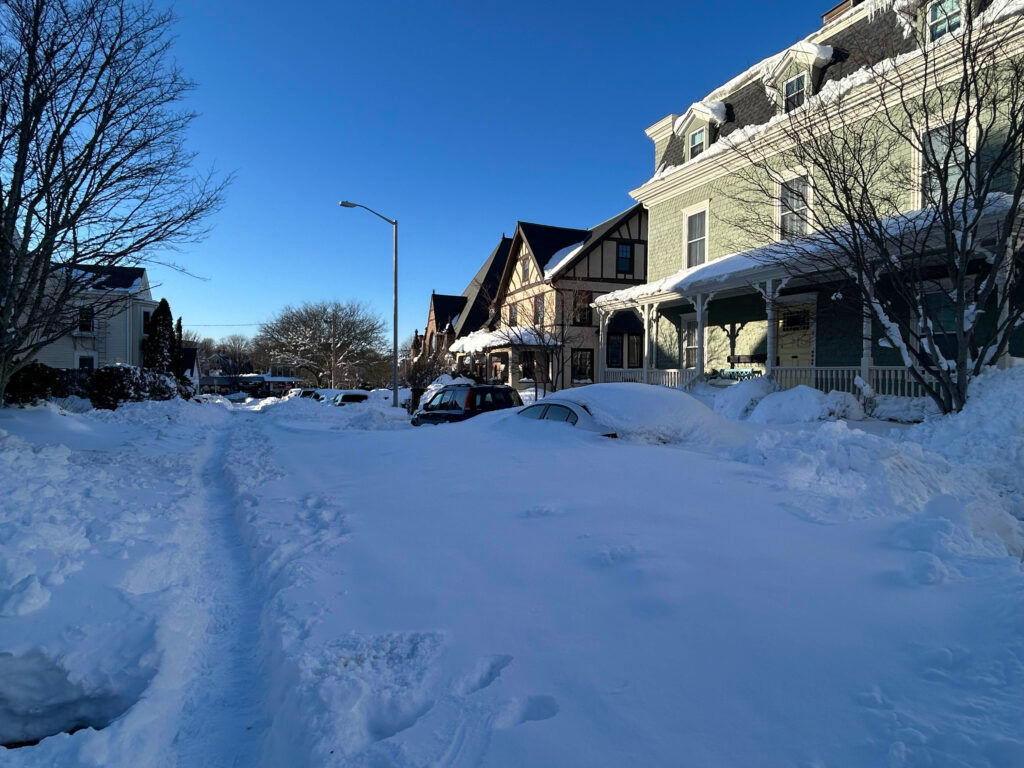
The blizzard, which swept across the region on Monday, February 23, 2026, brought unprecedented conditions to the state. Weather stations recorded 37.9 inches of snow at Rhode Island T.F. Green International Airport, establishing a massive total that paralyzed communities across the state.
The extreme snowfall eclipsed the long-standing record set during the historic Blizzard of 1978, which had blanketed the state with 28.6 inches of snow and remained the benchmark for extreme winter weather in Rhode Island for nearly fifty years.
Beyond the snow accumulation, the February 2026 storm packed the intensity of a Category 2 hurricane, generating peak wind gusts that reached 74 mph. The powerful winds tore down infrastructure, triggered severe whiteout conditions, and cut electrical power to thousands of households statewide.
The extreme weather left behind an estimated $19 million in total damage and municipal cleanup costs. State government operations absorbed roughly $9 million in response and recovery expenditures, while local cities and towns incurred an additional $10 million in emergency municipal costs.
Rhode Island's congressional delegation argued that examining the federal government's internal deliberations is necessary to verify whether Hamilton’s public explanations are genuinely supported by agency documentation. The lawmakers cautioned that if the agency fails to produce the records, it is only reasonable to conclude that FEMA’s rejection lacks any legitimate merit.
When asked to comment on the congressional inquiry, representatives from both FEMA and the Department of Homeland Security stood by the agency's previous determinations, reiterating Administrator Hamilton's position that the requesting states had failed to provide new information to justify overturning the initial denials.





(0)