
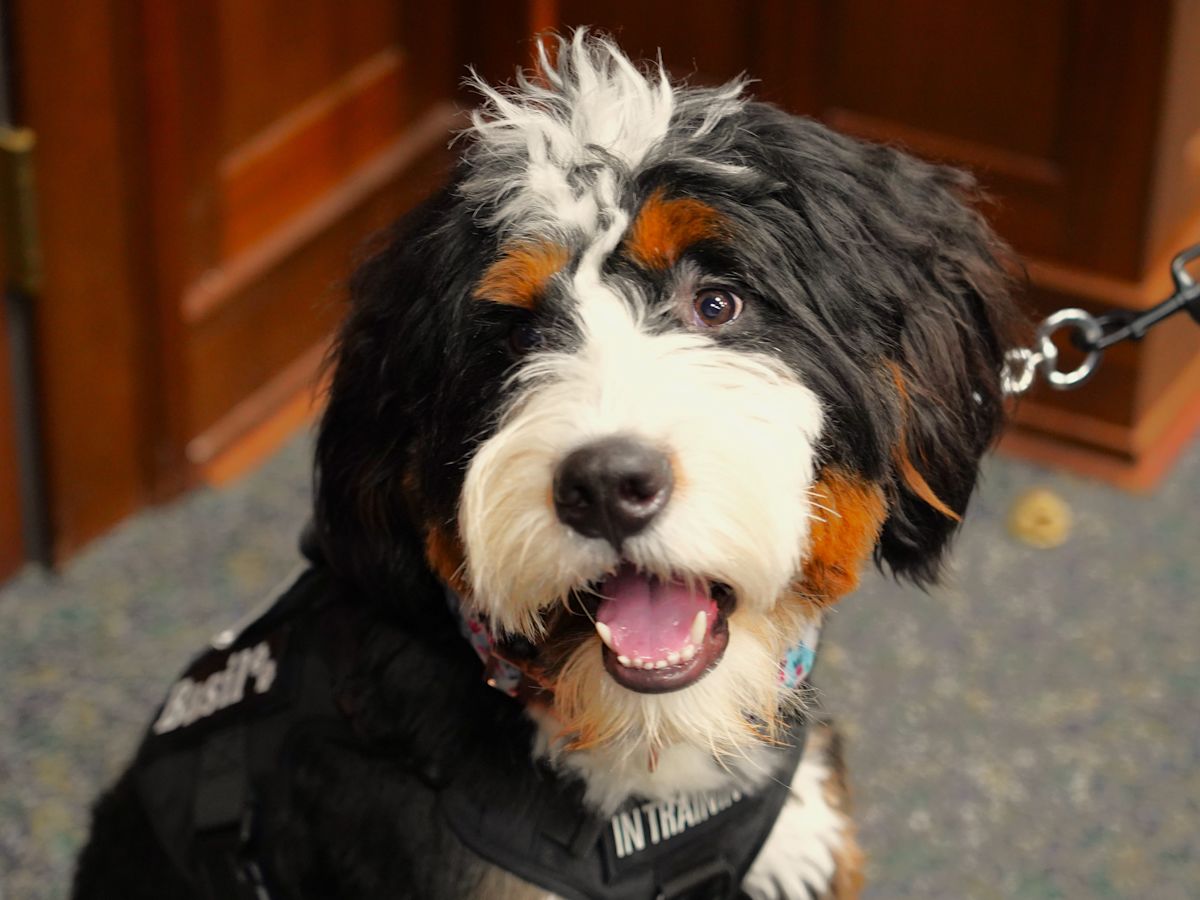
A jury summons in the mailbox is often met with hesitation, but residents called for grand jury service in Hamilton County, Ohio, encounter an unexpected and comforting presence in their daily routine. Alongside the prosecutors and detectives walking the office hallways, citizens are greeted by Basil, a dedicated therapy dog whose presence helps soften the atmosphere of serious legal proceedings.
Distinguished by a mop of white fur, a perpetually smiling expression, and a personalized vest displaying his name, Basil serves as an official therapy dog for the Hamilton County Prosecutor's Office. His primary role is to provide emotional comfort to crime victims, their family members, and the grand jurors tasked with evaluating evidence in emotionally taxing and traumatic cases.
Serving on a grand jury carries logistical differences and distinct perks when compared to standard trial juries. Jurors fulfill their civic duty away from the main courthouse, reporting instead to the prosecutor’s office building located on Ninth Street just one block away. This arrangement allows participants to bypass the lengthy daily security queues typically found at the main court facility.
Grand juries operate under a framework that is unfamiliar to many citizens accustomed to televised courtroom drama. While trial juries determine whether a defendant is guilty or not guilty, grand juries serve an entirely different gatekeeping function. Across the country, approximately half of all U.S. states utilize grand jury systems to review evidence and determine whether formal criminal charges should be filed.
Under Ohio law, grand juries are tasked with reviewing serious felony allegations rather than minor infractions. In Hamilton County, these panels examine all felony matters as well as any misdemeanor offenses connected to a felony charge. Unlike conventional trials, these proceedings do not take place before a judge in an open courtroom, nor do they involve arguments from defense attorneys or testimony from the accused.
Instead, grand jurors evaluate presentations delivered by prosecutors, law enforcement officers, and other witnesses who supply evidence. While defendants and their legal counsel are absent from the room, grand jurors are given the authority to directly question the detectives and police officers presenting each case to ensure clarity on the facts.
The fundamental legal standard governing these proceedings centers on establishing probable cause. The Ohio Judicial Council outlines that jurors must evaluate whether the submitted evidence is adequately credible and reliable to conclude that the accused person probably committed the alleged crime. That determination of probability serves as the benchmark for deciding whether a case proceeds to a full criminal indictment.
To secure an indictment, the threshold requires agreement from at least seven of the nine seated grand jury members assigned to the case. When that threshold is reached, the formal charges move forward into the broader judicial system.
In contrast, if a case fails to obtain the necessary seven votes, the matter is dismissed. Within the legal system, this outcome is referred to as a "no bill" or described as the grand jury having "ignored" the charges. However, such a decision does not permanently bar future prosecution, as prosecutors are permitted to present the case to a new grand jury if fresh evidence is uncovered.
Individuals who serve on these panels are chosen at random from local voter-registration files and driver's license databases. In Hamilton County, selected individuals complete a two-week service term during which they manage an intensive schedule, often reviewing 100 cases or more before their term concludes.
Hamilton County Prosecutor Connie Pillich noted that the county’s substantial case volume necessitates a continuous operation. Panels convene Monday through Friday across all 52 weeks of the year, pausing only for select holidays. To handle the steady flow of incoming criminal matters, the county operates two separate grand jury panels—each consisting of nine members along with alternates—every single business day.
The sheer scale of this gatekeeping process is reflected in the county’s annual figures. Pillich reported that more than 5,700 cases were presented to Hamilton County grand juries in 2025. Among the extensive array of criminal matters reviewed by jurors, cases involving drug possession and drug trafficking represent the largest single category on the docket.
The intense pace of daily operations is visible in the physical grand jury rooms themselves, where wood-paneled walls bear worn grooves and scratches from decades of chairs repeatedly rubbing against them. Unlike spacious courtrooms with high ceilings, the working rooms are relatively compact spaces dedicated to rapid, focused review.
Efforts have been made recently to modernize and improve these working conditions under the direction of Kate Burroughs, who assumed the role of Chief of Grand Juries and Intake in January 2025. Burroughs enlisted her daughters as volunteers to clean the spaces, patch the heavily worn seating, and introduce tables where none previously existed. A television monitor was also installed in the room, eliminating the previous necessity for detectives to walk around displaying video and photographic evidence directly from their mobile phones.
To prepare incoming citizens for the high-volume work ahead, the county provides an initial orientation on the first day of service. Jurors receive instruction on key legal principles and statutory definitions under Ohio law, including the exact legal meanings of terms such as knowingly, recklessly, and possession, alongside an overview of the state's active firearm statutes. To help new jurors acclimate to their responsibilities, the intake team assigns a lighter docket on day one before introducing more complex and demanding cases.
Through this structured process, county grand juries carry out essential legal work efficiently and without the posturing seen in typical trials. As Pillich observed, the proceedings operate without courtroom theatrics, allowing citizens—supported by modern updates and the calming presence of Basil—to focus strictly on the evidence.




(0)