
As the 2026 midterm election campaign heads into its decisive final seven weeks, the rapid proliferation of artificial intelligence has firmly established a new battleground in Texas politics. Campaigns across the state are increasingly turning to synthetic media and digital manipulation, using computer-generated video clips to lampoon opponents, distort records, and shape public perception in ways previously unseen in modern electoral contests.
Satire, caricature, and aggressive parody have long been foundational elements of American political discourse, tracing back centuries to the era of powdered wigs and early editorial drawings. In those early days, prior to the invention of photography and centuries before modern digital photo editing software, hand-drawn political cartoons were clearly recognizable as artistic commentary, leaving little doubt among the public about whether the depictions represented literal reality.
Today, however, the technological landscape has fundamentally shifted with the advent of artificial intelligence tools that allow virtually anyone with basic computer skills and existing source imagery to create convincing fabrications. These synthetic creations, widely referred to as deepfakes, can be produced rapidly and at minimal expense, making them readily accessible instruments for high-profile political campaigns seeking to influence voters online.
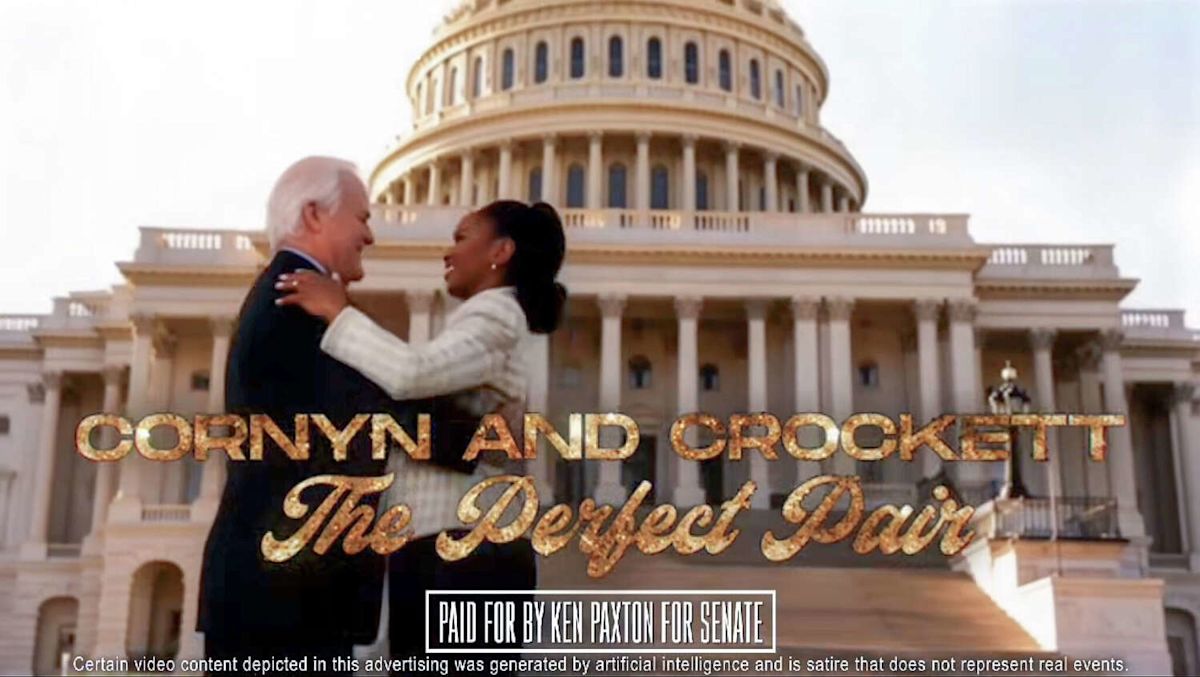
The tactical deployment of these AI tools became particularly prominent during the fiercely contested Republican primary for the U.S. Senate. Texas Attorney General Ken Paxton utilized the technology to target incumbent U.S. Senator John Cornyn, releasing a digitally generated video that falsely portrayed Cornyn dancing cheek-to-cheek with Democratic Representative Jasmine Crockett.
To heighten the political sting of the fabricated dance sequence, Paxton’s campaign interwove genuine news footage of Crockett speaking about past instances where she and Cornyn had cooperated on bipartisan legislative measures. By blending authentic commentary with synthetic visual fabrications, the advertisement sought to undermine Cornyn’s standing among conservative primary voters by exaggerating his ties to high-profile Democrats.
Cornyn responded to the attack with an AI-generated parody of his own, launching a retaliatory digital ad aimed directly at Paxton’s personal record. The incumbent senator's video depicted the state attorney general driving a 1960s-era vintage convertible, set against the soundtrack of a cover band performing the B-52s' hit song "Love Shack."
The imagery in Cornyn's counter-advertisement was designed to evoke reminders of Paxton's publicized personal controversies and alleged extramarital relationships, matters that had previously led Paxton's wife to initiate divorce proceedings. The exchange underscored how both campaigns were willing to lean heavily on synthetic media to highlight vulnerabilities and direct voter attention toward contentious personal and political issues.
Despite the intensity of the digital media blitz, the tangible electoral impact of the dueling deepfakes remains difficult to measure. Paxton debuted his dance video ahead of the March primary, in which Cornyn captured a plurality of votes but failed to secure the outright majority needed to prevent a secondary contest. Cornyn then unleashed his response during the subsequent runoff campaign, which culminated in Paxton securing the Republican nomination in a landslide victory.
Following his primary triumph, Paxton has continued to deploy AI-generated media as the race transitions into the general election contest against Democratic nominee James Talarico. Talarico, who secured the Democratic nomination after defeating Crockett without requiring a runoff election, has now become the central target of Paxton’s latest technological campaign offensives.
Talarico, a 37-year-old seminarian, has frequently discussed his religious faith on the campaign trail, presenting a progressive theological perspective. That approach has drawn sharp criticism from conservative Christian Republicans, who argue that his religious viewpoints stand in stark contrast to traditional conservative faith principles.
In a recent synthetic video produced by Paxton's campaign, an artificial depiction of Talarico is shown actively revising passages of the Holy Bible. The digital fabrication shows the Democratic candidate asserting that God created six distinct biological sexes and describing Jesus Christ as a radical feminist.
The deepfake features noticeable visual discrepancies, rendering Talarico with an appearance and voice that look roughly twenty years younger than his actual age. The attack references prior theological discussions by Talarico, who had previously addressed and walked back comments regarding multiple genders, clarifying that his original phrasing was a clumsy attempt to communicate a broader point during earlier discussions.
The emergence of these ads highlights ongoing debates surrounding the First Amendment, which protects freedom of speech, freedom of religion, and freedom of the press. Historically, political attacks and parodies have enjoyed broad constitutional protections, leading to complex legal considerations when applying traditional speech principles to hyper-realistic digital fabrications.
At the state level, Texas lawmakers attempted to address the emergence of deceptive election media by passing a statute in 2019 that explicitly bans the distribution of deceptive deepfake videos within 30 days of an election. The legislation was authored by Republican State Senator Bryan Hughes of Mineola, who emphasized the need to balance free expression while recognizing the emerging risks posed by deceptive visual media.
However, the state law contains a significant jurisdictional boundary that prevents it from restricting advertisements in federal races. Because candidates like Paxton, Cornyn, and Talarico have been competing for a seat in the United States Senate, their campaign communications fall outside the purview of the state statute's 30-day prohibition.
With federal campaigns remaining unrestricted by the state statute, voters across Texas are left to navigate an increasingly complex information environment on social media platforms. As the general election approaches its final weeks, the expanding use of synthetic media suggests that artificial intelligence will continue to play a prominent and contentious role in shaping the state's political discourse.


(0)